
Vacuum Parts Packaging: Comparing Bulk vs Retail Freight and Total Cost

Choosing vacuum parts packaging starts with understanding how each format affects shipping and preparation costs. Bulk packaging can reduce the space needed to ship vacuum replacement parts. Retail packaging can reduce the work needed after arrival. The better choice is the one that delivers acceptable, correctly identified parts in the required selling format at the lower total cost.
For importers, distributors and private-label sellers, that comparison should cover more than the packaging surcharge. Freight, local preparation, storage, rejected units and delivery timing can all change the result. Compare both options at the same endpoint: for example, inspected stock ready to sell from your U.S. warehouse.

This guide covers dry consumables such as filters, brushes, mop pads and dust bags. Batteries, electronics and cleaning liquids require a separate product-specific shipping and packaging review.
📌This article provides a reference framework for comparing packaging and shipping options. All product prices, packaging costs and freight rates in the worked example are hypothetical; they are not actual prices or quotations from techTongBo or any carrier. The right choice depends on the actual products, packed dimensions, destination, sales channel and available transport services. Confirm the details with your supplier before making a decision.
Vacuum Parts Packaging: Bulk and Retail Options
For this comparison, bulk packaging means products packed in counted groups inside shipping cartons, with the protection and identification appropriate to the part. It does not mean loose, unprotected products. A bulk order may still need individual sleeves, separators, inner bags or trays.
Retail packaging means each selling unit is individually packed and identified before shipment. That could be a labeled bag, a plain carton or a printed box. Retail packaging does not have to be large or decorative.
Separate three levels when requesting prices:
Packaging level | What to specify |
Protection around the part | Sleeves, bags, separators, inserts or supports |
The unit the customer buys | One filter, a two-filter pack or a mixed accessory kit |
Transport packaging | Master cartons, carton markings and any pallet arrangement |
Use the same product specification and selling unit in both quotations. A price for one loose filter cannot be compared directly with a retail pack containing two filters.
Also define where the work happens. Bulk shipment followed by local retail packing is a different operating model from bulk shipment directly to a repair business that uses the parts internally.

Calculate freight using the actual service
For a service using dimensional weight, a light carton may be charged according to the space it occupies. DHL Express describes volumetric weight using the carton dimensions in centimeters divided by 5,000, and compares this with actual weight. Confirm the divisor and billing rules for the specific service and account before booking. DHL Express: volumetric weight
For that illustrative metric calculation:
Volumetric weight in kg = external length × width × height in cm ÷ 5,000
Use the packed, closed carton's outside dimensions and its gross weight, including packaging. Do not substitute the product's dimensions or net weight. Confirm how the carrier rounds dimensions and weights, assesses individual pieces and applies surcharges.
FedEx's U.S. dimensional-weight explainer uses an inch-based calculation with a divisor of 139. A centimeter calculation and an inch calculation are different unit systems; do not mix their divisors. FedEx: dimensional weight
Smaller cartons do not automatically produce proportionate freight savings. If actual weight already determines the charge, reducing volume alone may not lower the billed weight. Rate brackets, minimum charges and other fees also need to be checked.
Do not apply the express formula to ocean freight. DHL Global Forwarding explains that LCL pricing uses weight or measurement and includes origin and destination charges. A reduction in cubic meters is useful input for a new quotation, not proof that the complete invoice will fall by the same percentage. DHL Global Forwarding: LCL cost drivers
For palletized shipments, request the loaded pallet dimensions, gross weight and stackability as well. The carton layout alone does not describe the final shipment.
Worked example: 1,000 replacement filters
All figures below are invented solely to demonstrate the calculation. They are not techTongBo packing specifications, carrier quotations, market prices or measured shipment results. Physical fit and product protection would need verification before using either arrangement.
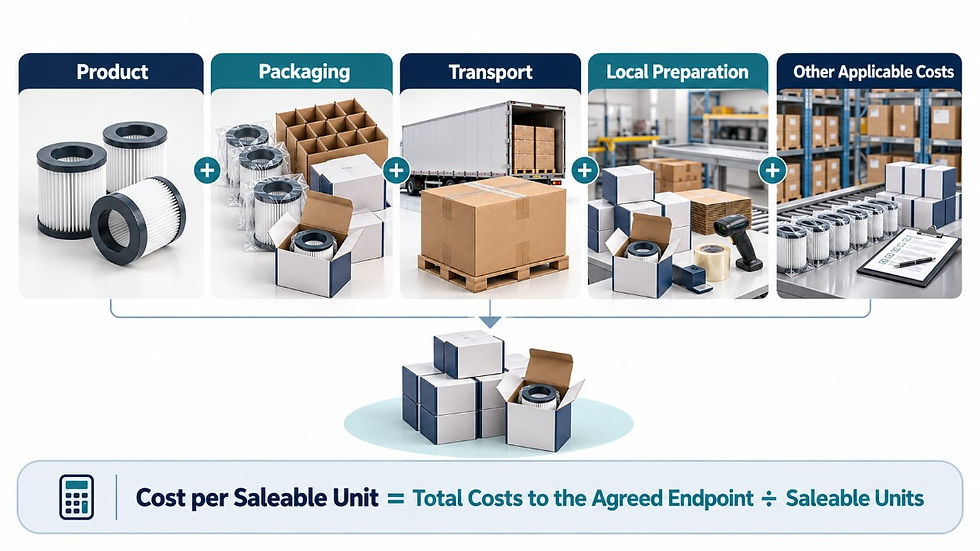
Assume a buyer orders 1,000 identical filters for sale as individual units. One option ships in bulk and receives its selling package locally. The other arrives individually retail-packed. Both must reach the same required selling condition.
Input | Bulk shipment | Factory retail-packed shipment |
Filters per shipping carton | 100 | 50 |
Number of cartons | 10 | 20 |
Outside carton dimensions | 50 × 40 × 30 cm | 50 × 40 × 35 cm |
Gross weight per carton | 12 kg | 7 kg |
Volumetric weight per carton, divisor 5,000 | 12 kg | 14 kg |
Higher of actual and volumetric weight per carton | 12 kg | 14 kg |
Sum of those carton weights, before service-specific adjustments | 120 kg | 280 kg |
Total carton volume, before any palletization | 0.60 m³ | 1.40 m³ |
The bulk carton calculation is 50 × 40 × 30 ÷ 5,000 = 12 kg. The retail carton calculation is 50 × 40 × 35 ÷ 5,000 = 14 kg.
For this example only, assume a linear transport charge of USD 4 per chargeable kilogram, with no additional charges in that illustrative line item. Actual services may use different rate structures.
The modeled transport cost is therefore USD 480 for bulk and USD 1,120 for retail-packed goods. Now include preparation costs.
Selected cost item | Bulk plus local packing | Factory retail-packed |
Identical products: 1,000 × USD 2.00 | USD 2,000 | USD 2,000 |
Origin packaging allocation | USD 100 | USD 350 |
Illustrative transport line item | USD 480 | USD 1,120 |
Local conversion to the required selling format | USD 400 | USD 0 |
Selected-cost subtotal | USD 2,980 | USD 3,470 |
Subtotal per unit, assuming all 1,000 remain saleable | USD 2.98 | USD 3.47 |
Origin packaging includes the respective protective and transport materials; the retail option also includes its selling package. The bulk option's local conversion allowance includes replacement selling materials, packing labor and labeling.
This is not a complete landed-cost quotation. It excludes separately assessed surcharges, insurance, customs clearance, duties and taxes, storage, financing, losses and downstream fulfillment. Add the applicable items without counting charges already included in a supplier or freight quotation twice. An excluded cost should only be treated as identical after checking both routes.
The useful result is the break-even allowance for local preparation. Before local conversion, the modeled bulk route saves USD 890: USD 250 in origin packaging and USD 640 in transport. With equal saleable quantities and other costs, that leaves USD 0.89 per ordered filter for local conversion before its advantage disappears.
At the assumed USD 0.40 local conversion cost, the remaining advantage is USD 0.49 per filter. This is a decision method, not a promised saving.
Compare cost per saleable unit
Use a broader comparison once actual quotations are available:
Cost per saleable unit = total costs through the agreed endpoint ÷ units accepted and ready for sale
The numerator should include product cost, packaging, transport, applicable import and handling charges, local preparation, storage and rework within that boundary. Recoverable taxes should be tracked consistently with the buyer's accounting treatment.
The denominator matters. If damaged or incorrectly packed products cannot be sold, dividing by the original ordered quantity understates the cost of the usable stock. The original cost of those rejected products is already in the numerator; do not add it again as a second loss. Add only further costs actually incurred, such as disposal or rework, and account for supplier credits consistently.
To extend the example, if the bulk route still costs USD 2,980 but only 980 units are saleable, its selected-cost subtotal becomes approximately USD 3.04 per saleable unit. This is another hypothetical sensitivity calculation, not an assumed damage rate.
Also evaluate preparation capacity. A low labor quotation is less useful if the warehouse cannot process the shipment before a selling deadline. Record the expected time from receipt to saleable stock for both options.
Protect the parts that determine performance
Packing density must be checked against the function of the product. The following are proposed inspection points, not claims about measured failure rates.
Part | What to examine after packing and handling trials |
Pleated filters | Pleat condition, frame distortion, sealing surfaces and cleanliness |
Main brushes | Shaft or end-cap damage, roller shape and freedom of movement |
Side brushes | Bristle shape, hub condition and separation from heavier parts |
Dust bags | Collar condition, seams, closures and freedom from punctures |
Mop pads | Dryness, cleanliness, attachment backing and recovery from compression |
Roller mops | Surface condition, core alignment and fit after unpacking |
Ask for photos of the proposed layout and a packed sample. Where the route warrants it, agree on compression, vibration and drop evaluation with a packaging specialist, using conditions appropriate to the shipment. Do not describe an arrangement as tested or certified without the corresponding evidence.
UPS recommends rigid boxes, appropriate cushioning and secure packing. Use its general guidance alongside product-specific validation. A printed retail box is not automatically a suitable parcel shipping container. UPS: packaging guidance

Request comparable supplier quotations
Give the supplier one shared product specification and ask for separate packing proposals. The quotation should make these inputs visible:
Exact part number, material specification, quantity and definition of a selling unit.
Units per inner pack and master carton, including the final partial carton.
Closed carton outside dimensions, net weight and gross weight.
Protective materials, artwork, labels and identification by SKU and batch.
One-time setup or tooling charges, recurring packaging charges and unused packaging ownership.
Production time, packaging-material lead time and packed-sample approval.
Shipment origin, destination, transport service and quotation validity.
Agreed delivery term and named place, with included and excluded charges identified.
For mixed cartons, require a packing list that maps each SKU and quantity to the carton number. That makes receiving and shortage checks easier to plan.
Request local preparation costs from the warehouse at the same time. Separate per-unit labor from minimum job charges, materials, storage and disposal. Ask whether relabeling or repacking delays availability for sale.
For part selection, start with the techTongBo product catalog. Use the bulk purchasing FAQ to frame the inquiry, and include the packaging comparison in your discussion with the wholesale parts supplier.
Choose packaging for the sales channel
Bulk packaging is worth evaluating when the receiving business uses the parts directly, assembles its own kits or already has efficient local packing capacity. It may also allow one common inventory pool to serve several selling formats.
Factory retail packing is worth evaluating when the selling format is fixed and the warehouse needs individually identified units ready for distribution. Include artwork setup, minimum packaging quantities and the risk of unused printed packaging if the range changes.
A compact labeled pack can be a useful third option. Compare it with both grouped bulk packing and a full retail box rather than assuming that every retail order needs a large carton.
Before approval, check the actual retailer or fulfillment provider's current packaging and labeling requirements. Passing a general shipping review does not establish acceptance by a particular sales channel.
If you have no specific packaging or shipping requirements, start by talking to your supplier. Share the information you have about the parts, approximate order quantity, destination, sales channel and delivery expectations. Ask your supplier to help clarify the requirements and recommend suitable packaging and transport options, explaining the trade-offs in protection, cost and delivery time. You do not need to decide on carton dimensions or a shipping service before asking for advice.
For example, buyers working with techTongBo can ask the team to recommend packaging and shipping options based on their order and intended use. The same approach applies when working with your own supplier.
Use the calculations in this article as a way to ask better questions and compare proposals. Final packaging and transport decisions should follow the actual order conditions and the details agreed with your supplier.
Frequently asked questions
Is bulk packaging always cheaper?
No. Its packaging and inbound freight advantage can be offset by local labor, materials, storage, rework or fewer saleable units. Compare both options at the same endpoint.
Does reducing carton volume always reduce freight?
No. The outcome depends on actual versus volumetric weight, rate brackets, minimums and additional charges. Obtain revised quotations using the final packed measurements.
Can a retail box be shipped directly to the end customer?
Only if it provides the necessary transport protection and satisfies the chosen carrier and channel requirements. Some retail packs still require a shipping carton or mailer.
Can one volumetric-weight formula be used for every route?
No. Confirm the units, divisor, rounding and pricing method with the provider. Express-parcel calculations should not be carried over to LCL or FCL ocean quotations.
What if I have not decided on packaging or shipping requirements?
Contact your supplier with the information you have, even if you have no specific requirements yet. Ask for a recommendation based on the products, quantities, destination, intended sales channel and delivery needs. Suppliers such as techTongBo can help buyers assess these options. Confirm the proposed packaging, shipping method and included services with your supplier before proceeding.
techTongBo (also named: Nanjing TongBo / NJTB) is a Chinese company specializing in the manufacture and sales of vacuum cleaner accessories. We offer replacement accessories for the global market that are compatible with mainstream vacuum cleaner brands and have stronger price advantages.


Comments