
Private Label Robot Vacuum Accessories: A Practical Buyer's Guide for New Brands

The global robot vacuum market has grown rapidly over the past few years, creating strong demand for replacement consumables such as filters, roller brushes, side brushes, mop pads, and dust bags. According to recent industry research from IDC and market data published by Statista, the global home cleaning robot market continues to expand as adoption increases across residential markets worldwide. For distributors, online sellers, retailers, and cleaning brands, Private Label Robot Vacuum Accessories provide an opportunity to build recurring revenue without developing an entirely new product from scratch.
However, many first-time buyers assume that private label simply means printing a logo on an existing product. In reality, successful private label projects begin long before production. Choosing the right models, understanding compatibility, planning inventory, and working with an experienced manufacturer all have a direct impact on long-term profitability.

This guide shares practical sourcing advice based on common challenges faced by distributors and private label buyers, helping you build a product line with lower risk and better long-term potential.
Choose the Right Private Label Robot Vacuum Accessories Instead of Chasing Every Model
One of the most common mistakes new buyers make is trying to cover every robot vacuum model available. While offering hundreds of SKUs may sound attractive, it often leads to slow inventory turnover, higher purchasing costs, and more complicated warehouse management.
Instead of choosing products based on intuition, start with market demand.
When selecting your first product line, consider the following factors:
Selection Factor | Why It Matters |
Amazon Best Sellers | |
Brand Installed Base | Brands with a larger installed user base usually generate more replacement accessory sales. |
Product Launch Date | Models launched 2–4 years ago often create more stable demand because more users have reached the replacement cycle. |
Replacement Frequency | Filters, dust bags, and mop pads require regular replacement, making them ideal products for repeat sales. |
SKU Complexity | Starting with 20–30 carefully selected models is usually easier to manage than launching hundreds of SKUs. |
Many buyers only focus on the latest robot vacuum releases, believing newer models create better business opportunities. In practice, mature models often provide a much healthier balance between demand and inventory risk.

For example, brands such as Roborock, Dreame, Ecovacs, iRobot, and Shark have built large user bases over several years. Their popular models continue generating steady demand for compatible replacement accessories long after the original robot vacuum is released.
Factory Insight: At techTongBo, we've found that the products with the highest reorder rates are not always designed for the newest robot vacuum models. More often, they are compatible with machines that have been on the market for several years. As the installed user base grows, replacement demand becomes more predictable, making inventory planning easier for distributors and private label brands.
Compatibility Matters More Than Appearance
Many replacement parts look almost identical in product photos, but even small structural differences can prevent proper installation.
Before confirming production, always verify:
✅Exact robot vacuum model
✅Regional version (if applicable)
✅Self-empty dock or charging station version
✅Product dimensions and mounting structure
✅Filter thickness, brush shaft design, or locking mechanism
One practical mistake we often see is buyers comparing products only by appearance. A filter that is just 1–2 mm thicker, or a roller brush with a slightly different end cap, may fit poorly or reduce cleaning performance.
For this reason, requesting physical samples before mass production is still the most reliable way to verify compatibility.
Start Small, Then Expand Based on Real Sales Data
Successful private label businesses rarely begin with large purchase orders.
A lower-risk approach is:
Select several high-demand products.
Request samples from the manufacturer.
Test compatibility and product quality.
Launch a small trial order.
Analyze customer feedback and sales performance.
Expand the product range based on actual market demand.
This strategy allows you to build inventory with confidence instead of relying on assumptions. It also helps identify your best-selling products before committing significant purchasing budgets.

How to Choose a Manufacturer That Truly Supports Private Label Projects
Not every factory that offers logo printing is equipped to support a successful private label business. A reliable manufacturing partner should help you build a consistent brand experience, not simply produce compatible replacement parts.
Before placing your first order, ask potential suppliers the following questions:
What to Evaluate | Why It Matters |
Private label packaging | Can the supplier customize retail boxes, labels, manuals, and barcodes? |
Product consistency | Will every production batch maintain the same quality and specifications? |
Quality control process | Does the factory inspect raw materials, production, and finished products? |
Sample support | Can samples be provided quickly for compatibility testing? |
Production capacity | Can the supplier support your business as order volume grows? |
Communication efficiency | Can technical questions and after-sales issues be resolved quickly? |
Price is important, but it should never be the only factor. A slightly lower unit cost may lead to inconsistent quality, delayed shipments, or customer complaints that ultimately cost much more than the initial savings.
A professional manufacturer should also be able to recommend suitable products based on your target market instead of simply accepting every purchase request.
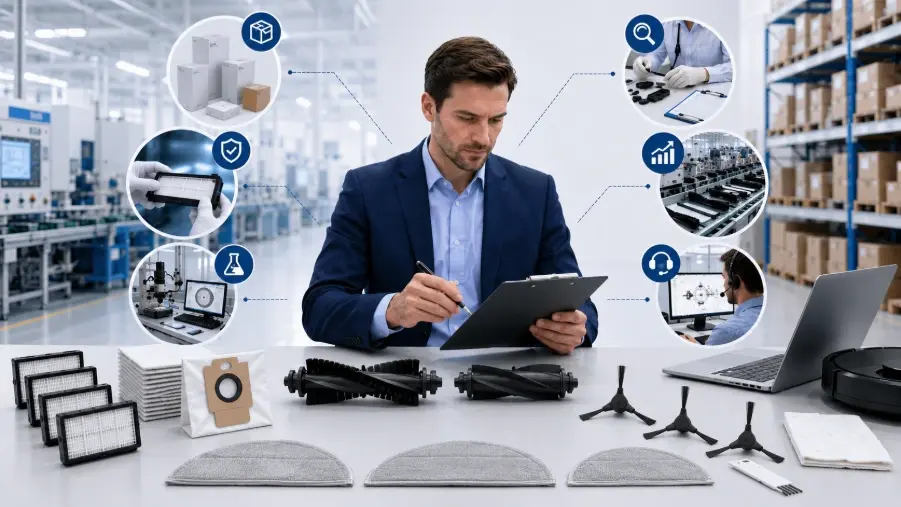
Sell Complete Accessory Kits Instead of Individual Parts
Many distributors begin by purchasing individual replacement parts such as filters or roller brushes. While this approach works, complete accessory kits often create a better customer experience and increase average order value.
A typical replacement kit may include:
HEPA filters
Main roller brush
Side brushes
Mop pads
Dust bags
Cleaning tool
Accessory kits also simplify inventory management because customers can replace multiple consumable parts at the same time instead of purchasing each item separately.
For e-commerce sellers, complete kits often perform better because they provide a convenient "one purchase, complete maintenance" solution.
Common Mistakes New Private Label Buyers Should Avoid
Even experienced importers occasionally make mistakes when entering the robot vacuum accessories market. Fortunately, most of them can be avoided with proper planning.
⚠️Some of the most common mistakes include:
Choosing products based only on appearance instead of verified compatibility.
Purchasing too many SKUs before understanding actual market demand.
Selecting suppliers based only on the lowest quotation.
Ignoring packaging quality and brand presentation.
Skipping sample testing before mass production.
Focusing only on newly released robot vacuum models while overlooking mature products with stable replacement demand.
Building a successful private label business is usually a gradual process. Buyers who validate products, collect customer feedback, and expand step by step are generally more successful than those who attempt to launch a large product catalog immediately.
Conclusion
Private label robot vacuum accessories continue to offer excellent opportunities for distributors, retailers, and online sellers. Success depends not only on competitive pricing but also on choosing the right products, verifying compatibility, working with reliable manufacturing partners, and building a product range that meets long-term market demand.
At techTongBo, we work with distributors, wholesalers, and private label brands around the world, supporting compatible replacement parts for leading robot vacuum and vacuum cleaner brands. Beyond manufacturing, we also assist customers with product selection, compatibility evaluation, packaging customization, and accessory kit planning to help them build sustainable product lines.
Whether you are launching your first private label project or expanding an existing brand, careful planning at the beginning can save significant costs and create stronger long-term growth.
Frequently Asked Questions
What are private label robot vacuum accessories?
Private label robot vacuum accessories are compatible replacement parts manufactured by a supplier and sold under your own brand name.
Which replacement parts sell best?
HEPA filters, dust bags, roller brushes, side brushes, and mop pads are typically the fastest-moving consumable products because they require regular replacement.
How many SKUs should I launch first?
Most new buyers can start with approximately 20–30 carefully selected high-demand SKUs and expand according to actual sales performance.
Should I only sell the newest robot vacuum models?
Not necessarily. Mature models often generate more stable replacement demand due to their larger installed user base.
How do I choose the right manufacturer?
Look beyond pricing. Evaluate product quality, compatibility expertise, quality control, packaging customization, communication, and long-term production capability.
Ready to Build Your Private Label Product Line?
If you're looking for a manufacturing partner with experience in compatible robot vacuum and vacuum cleaner replacement parts, feel free to contact techTongBo.
We're happy to discuss your product ideas, evaluate compatibility, and explore packaging or private label solutions that fit your business goals.
techTongBo (also named: Nanjing TongBo / NJTB) is a Chinese company specializing in the manufacture and sales of vacuum cleaner accessories. We offer replacement accessories for the global market that are compatible with mainstream vacuum cleaner brands and have stronger price advantages.


Comments