Robot Vacuum Suction Power: Is Higher Pa Better?

A robot vacuum rated at 20,000 Pa is not automatically twice as effective as a 10,000 Pa model. Robot vacuum suction power measures the pressure created by the suction system, but real cleaning also depends on airflow, brush design, filter condition and airtight seals.
This guide explains what Pa means, how much suction different homes need, and why replacement parts can have a major effect on pickup.

What does Pa mean?
Pa stands for pascal, a unit of pressure. In a robot vacuum, it describes the pressure difference produced by the suction system under a specific test condition.
Pressure and airflow are related, but they are not the same:
Pressure helps lift debris against resistance.
Airflow carries that debris through the intake and into the dustbin.
The roller brush loosens hair and dirt before suction collects it.
A blocked filter or narrow air path can restrict airflow even when the motor is powerful. The advertised Pa figure is also usually a maximum value. Quiet and standard modes run at lower power.

Is higher robot vacuum suction power better?
Higher robot vacuum suction power can improve pickup on carpet and heavier debris, but Pa alone does not predict cleaning quality.
🔎Test methods vary
Brands may measure pressure at different points and under different conditions. Battery charge, filter installation, seals and test equipment can all affect the result. Pa is useful when comparing modes within one product line, but cross-brand comparisons are less reliable.
🔎Maximum mode reduces runtime
Maximum suction uses more energy and usually creates more noise. If the robot cannot finish the mapped area, a lower setting with complete coverage may clean more effectively.
🔎The brush must reach the dirt
On carpet, the main roller loosens trapped dust and hair. A worn, tangled or poorly fitted brush can limit pickup, regardless of the motor rating.
🔎Air leaks waste suction
Gaps around the dustbin, filter frame, air channel or dust-bag connector reduce the pressure available at the floor.
🔎Navigation still matters
A robot cannot collect dirt from areas it misses. Mapping, edge coverage and obstacle avoidance remain part of overall cleaning performance.
The sensible approach is to treat Pa as one specification, not a final score.

How much suction do you need?
There is no universal Pa threshold because brands do not always test products in the same way. These broad ranges can be used as a starting point:
Cleaning situation | Reference range | Also look for |
Dust on tile or sealed wood | 4,000–8,000 Pa | Good floor contact and side-brush control |
Low-pile carpet | 6,000–10,000 Pa+ | Carpet boost and an effective main roller |
Long pet hair | 6,000–12,000 Pa+ | Anti-tangle brush and easy maintenance |
Cat litter and larger crumbs | 8,000–15,000 Pa+ | Wide intake and suitable roller clearance |
Medium-pile carpet | 10,000 Pa+ | Strong brush action and carpet detection |
These are shopping references, not industry standards.
On hard floors, excessive side-brush speed may scatter larger particles before the intake reaches them. On carpet, brush agitation and airflow often matter more than a small difference in Pa.
Pet hair is mainly a brush-system challenge. An anti-tangle roller with the correct size and floor contact may deliver a bigger improvement than a higher motor rating.
What else affects cleaning performance?
✅Main roller
The roller guides debris into the intake. Wrapped hair increases resistance, while worn fins or bristles reduce floor contact. A replacement brush must match the original length, diameter, connector and end-cap design.
✅Filter
Dust buildup increases airflow resistance. Clean the filter only as directed by the manufacturer, and reinstall washable filters only after they are completely dry. Replace filters that remain clogged, damaged or deformed.
✅Dustbin, dust bag and seals
A full dustbin or station bag restricts airflow. Incorrect dust-bag collars and damaged seals can also cause leaks. Even a small gap may reduce suction or release fine dust.
✅Side brush and navigation
The side brush moves edge debris toward the intake. Its angle and stiffness affect whether particles are collected or scattered. Navigation determines whether the robot covers the full area.

Why does suction become weaker?
Weak suction does not always mean motor failure. Check the airflow system first.
Empty the dustbin.
Replace a full or clogged station dust bag.
Clean or replace the filter.
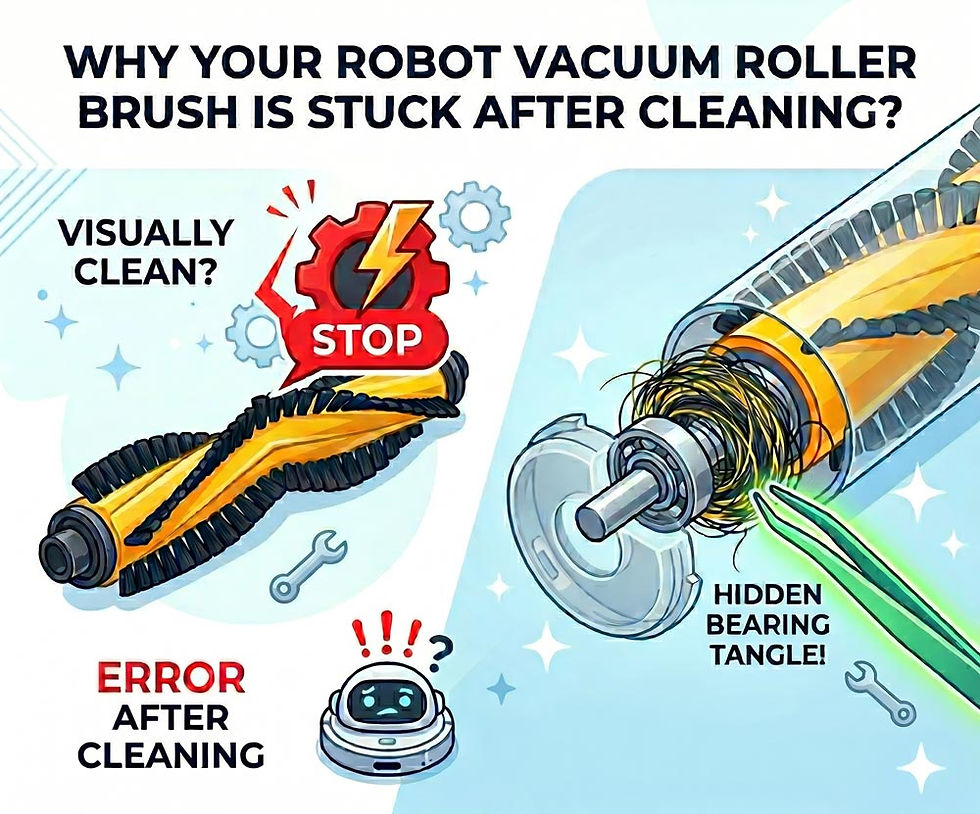
Remove hair from the roller and end caps.
Check the intake and air channel for blockages.
Reseat the dustbin and filter.
Inspect gaskets and sealing surfaces.
Confirm that the robot is not running in quiet mode.
Test the robot on a small area after maintenance. If pickup remains poor in several power modes, the fan motor, battery or an internal sensor may need professional inspection.
What parts buyers should check
For distributors, repair centers and ecommerce sellers, visual similarity does not confirm compatibility. Replacement parts must also match the machine's dimensions and airflow system.
⚠️Check:
Roller length, diameter, connector and end caps
Filter size, frame rigidity and sealing edge
Dust-bag collar shape and material
Dustbin seals and air-channel alignment
Side-brush connector and bristle design
Installation results on the specified model
A filter that does not seal correctly can allow bypass leakage. An inaccurate roller may sit too high or too low. A poorly fitted dust bag can reduce station suction or release dust.
techTongBo supplies compatible brushes, filters, dust bags and other vacuum cleaner parts for distributors, repair businesses, ecommerce sellers and private-label projects. Send us the brand, model number, part photos and required quantity for compatibility support.
FAQ
Is 10,000 Pa good for a robot vacuum?
It is a strong advertised rating for many homes, including those with low-pile carpet or pets. Actual pickup still depends on the roller, airflow, seals and test method.
Is 20,000 Pa too much for hardwood floors?
It is not usually harmful to sealed hard floors, but maximum mode may be unnecessary for routine dust. Automatic or standard mode can reduce noise and save battery.
How much suction is needed for pet hair?
About 6,000–12,000 Pa or more can be used as a broad reference. Brush design and resistance to tangling are often more important than the Pa difference between two models.
Can a dirty filter reduce suction?
Yes. A clogged filter restricts airflow. Clean it as instructed or replace it if airflow does not recover. Never reinstall a washable filter while it is damp.
Can Pa ratings be compared directly between brands?
Not always. Test conditions may differ. Compare independent floor tests, runtime, brush design and replacement-part availability as well.
Conclusion
Robot vacuum suction power matters, but the largest Pa number is not automatically the best choice. Effective cleaning requires pressure, airflow, a correctly fitted roller, a clean filter and intact seals.
Regular maintenance often restores more performance than leaving the robot in maximum mode. For replacement-parts buyers, accurate fit and airflow compatibility matter as much as appearance.
Need compatible robot vacuum brushes, filters or dust bags? Contact techTongBo with the brand, model number, part photos and expected quantity for matching and wholesale support.
techTongBo (also named: Nanjing TongBo / NJTB) is a Chinese company specializing in the manufacture and sales of vacuum cleaner accessories. We offer replacement accessories for the global market that are compatible with mainstream vacuum cleaner brands and have stronger price advantages.