
Why Your Robot Vacuum Roller Brush Is Stuck Even After Cleaning: Solving the Hidden Bearing Tangle

In the daily maintenance of robot vacuums, many users—and even tech-savvy enthusiasts—encounter a frustrating paradox: you’ve meticulously cut away every visible hair from the brush surface, yet shortly after restarting, the machine triggers the dreaded "Roller Brush Stuck" error again.
This contradiction between a "visually clean" brush and a "system error" usually points to a frequently overlooked mechanical blind spot: the "Deadly Tangle" inside the brush bearings.

The Hidden Killer: Hair Accumulation Inside the Bearings
As the roller brush spins at high speeds, hair doesn't just wrap around the bristles; centrifugal force and airflow push fine strands toward both ends of the brush axis. These microscopic fibers slip into the tiny gaps between the Brush Cap and the Bearing Housing, winding tightly around the internal shaft.
Why does this trigger a system error?
Surge in Mechanical Resistance: Hair accumulated inside the cap acts like a tightening gasket, creating massive friction.
Friction Heat Effect: At high RPMs, the friction between trapped hair and plastic components generates intense heat, which can lead to localized melting of plastic parts, permanently seizing the bearing.
Motor Overload Protection: The motherboard detects an abnormal spike in the current required to drive the brush. To prevent the motor from burning out, the system triggers a forced shutdown error.
Deep Cleaning Guide: How to Fix a Robot Vacuum Roller Brush Stuck Internally
1. The Critical Step Most People Miss: Removing the End Caps
Most flagship models from leading brands (such as Roborock, Dreame, and Ecovacs) now feature a removable end cap design.
Operation: After clearing surface hair, firmly pull or twist off the plastic caps at both ends of the roller brush.
The Discovery: You will often find a thick, compressed "hair washer" tightly wound around the inner axle. These must be extracted using needle-nose pliers or tweezers.
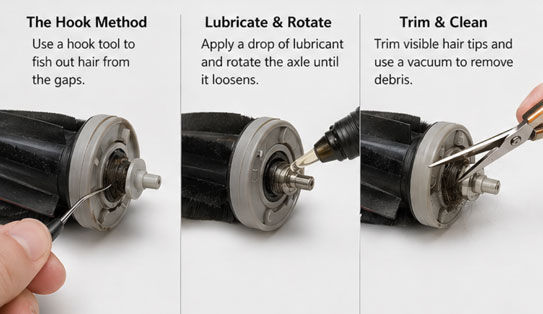
2. The Tough Challenge: What if the End Caps are "Non-Removable"?
Some entry-level or older models have end caps that are fixed or welded. For these designs, use these professional techniques:
The Hook Method: Use a thin dental probe or a sewing needle with a micro-hooked tip. Insert it into the gap of the end cap and slowly fish out the internal hair bit by bit.
Physical Intervention: If the rotation feels gritty, apply a tiny drop of high-precision instrument lubricant to the shaft and manually rotate it until it loosens. Caution: Never use corrosive solvents, as they will destroy the bearing seals.
Preventative Trimming: If any hair tips are visible in the gap, trim them with fine beauty scissors and use a high-powered vacuum to suck out the debris.

techTongBo Manufacturing Perspective: Professional Advice for Accessory Replacement
As a factory specialized in the R&D and manufacturing of vacuum accessories, techTongBo has found through long-term data testing that compatibility is about more than just "fitting in"—it’s about "precision synergy." Below are our key maintenance and installation insights:
High-Precision Tolerance Compensation: Due to variations across different production years and OEMs, a "Tolerance Stack-up" of 0.1mm to 0.5mm often exists within the brush compartments of different host machines. When designing replacement brushes, techTongBo implements a High-Precision Compensation Design for the axle-to-cap fit.
The Pro Test: After installing a new accessory, flick the brush with your finger. In a non-powered state, it should achieve 3 to 5 smooth rotations via inertia. If you feel significant resistance, check the brush housing for Assembly Interference.
Secondary Inspection of the Drive Socket: Before installation, inspect the drive socket. Hair wedged in the perimeter gap creates a "braking effect," triggering the Robot Vacuum Roller Brush Stuck error. Use a toothpick or pin to extract any compressed hair rings from this interface.
Physical Material Properties: Premium replacements utilize low-friction engineering plastics. techTongBo advises B2B clients to emphasize the importance of "Deep Maintenance" (removing end caps) to end-users, which can extend motor lifespan by over 30%.
"Acoustic" Maintenance & Manual Adjustment: Listen closely during the first run. A high-pitched whistling or grinding sound indicates the axle seals may need a position adjustment. techTongBo accessories are designed to support Manual Micro-Adjustment to achieve perfect synergy with different host batches. For distributors, teaching a customer to "slight pull the end cap" is far more cost-effective than processing a return.
Summary: Ending the Cycle of a Robot Vacuum Roller Brush Stuck Error
To resolve a "Robot Vacuum Roller Brush Stuck" error, you must look beyond the surface and clear hidden hair from internal bearings and drive slots. By pairing deep maintenance with techTongBo’s adjustable, precision-engineered accessories, you can overcome manufacturing tolerances, restore peak cleaning power, and significantly extend your motor’s lifespan.
techTongBo (also named: Nanjing TongBo / NJTB) is a Chinese company specializing in the manufacture and sales of vacuum cleaner accessories. We offer replacement accessories for the global market that are compatible with mainstream vacuum cleaner brands and have stronger price advantages.


