
Robot Vacuum Replacement Parts After Prime Day: What Amazon Sellers Should Stock

Prime Day does not only create robot vacuum sales. It also creates delayed demand for replacement parts. For Amazon sellers, robot vacuum replacement parts after Prime Day can become a valuable but often overlooked sales opportunity.
As a robot vacuum accessories manufacturer, techTongBo works with ecommerce sellers, distributors, and repair centers that need model-specific replacement parts, refill kits, and wholesale accessory supply. Based on this aftermarket supply experience, this guide explains which parts sellers should watch after Prime Day and how to plan stocking timelines when sourcing from China.

When shoppers buy discounted robot vacuums during Prime Day, the demand for dust bags, HEPA filters, mop pads, side brushes, and main roller brushes usually appears later — often 30 to 90 days after the original machine purchase. In 2026, Amazon Prime Day is scheduled for June 23–26, so sellers should start planning before replacement demand becomes visible.
Why Demand for Robot Vacuum Replacement Parts After Prime Day Increases
Most robot vacuum accessories are not purchased at the same time as the machine. New users usually test the robot first. After several weeks of daily cleaning, they begin to notice dirty mop pads, full dust bags, clogged filters, worn side brushes, or tangled roller brushes.
This creates a delayed sales window for replacement parts.
Replacement Part | Likely Demand Window After Machine Purchase | Why It Matters |
Dust bags | 30–60 days | Self-emptying dock users need regular refills |
Mop pads | 30–60 days | Mopping models create frequent cleaning and replacement needs |
HEPA filters | 30–90 days | Filters affect suction, airflow, and dust control |
Side brushes | 60–90 days | Low-cost parts that wear from edge cleaning |
Main roller brushes | 60–120 days | Higher-value parts, especially important for pet hair homes |
The exact timing depends on cleaning frequency, home size, pet hair, floor type, and user habits. But for sellers, the message is simple: waiting until customers start searching may be too late.
Robot Vacuum Model Groups Sellers Should Watch
Sellers do not need to stock parts for every robot vacuum model. A better approach is to watch model groups that are likely to receive strong visibility during major shopping events.

Model Group to Watch | Why Sellers Should Care | Parts Likely to Move |
Roborock Qrevo / Q series type models | Popular self-emptying and mop-washing robot vacuums | Dust bags, mop pads, filters, brushes |
eufy X10 Pro Omni type models | Value all-in-one station models with strong feature appeal | Mop pads, dust bags, filters |
Dreame L10s / L40 / X40 type models | High-end dock models with multiple consumables | Complete kits, filters, mop pads, dust bags |
Strong U.S. pet-hair cleaning demand | Filters, side brushes, main brushes | |
iRobot Roomba Combo / Plus type models | Large user base and steady maintenance demand | Filters, side brushes, main brushes, dock bags where applicable |
However, sellers should not stock only by brand name. Always check the exact model number, U.S. version, dock design, and accessory shape.
For example, some self-emptying models use dust bags, while some bagless bases do not. Stocking dust bags for the wrong dock type can lead to returns and slow-moving inventory.
Which Replacement Parts Should Sellers Prepare First?
For most Amazon sellers, the safer first order is not a large quantity of one single part. A mixed batch of refill kits and complete maintenance kits for several high-visibility models is usually safer.
Priority | Parts | Why |
High | Dust bags | Strong repeat demand from self-emptying dock users |
High | Mop pads | Frequent replacement for robot vacuum and mop models |
High | HEPA filters | Linked to suction, dust, pet hair, and allergy concerns |
Medium | Side brushes | Low-cost parts, useful for kits and multi-packs |
Medium | Main roller brushes | Higher value, stronger demand after longer use |
Selective | Dock parts / repair parts | Better for repair centers or small test orders |
A practical stocking strategy is to separate products into three kit types:
Kit Type | Best Timing | Suggested Parts |
Refill kit | 30–60 days after Prime Day | Dust bags, filters, mop pads |
Complete maintenance kit | 60–90 days after Prime Day | Main brush, side brushes, filters, mop pads, dust bags |
Pet hair maintenance kit | 60–90 days after Prime Day | Main brush, HEPA filters, side brushes |
This helps sellers match product listings with real customer behavior instead of creating random accessory bundles.
When Should Sellers Stock If Buying From China?
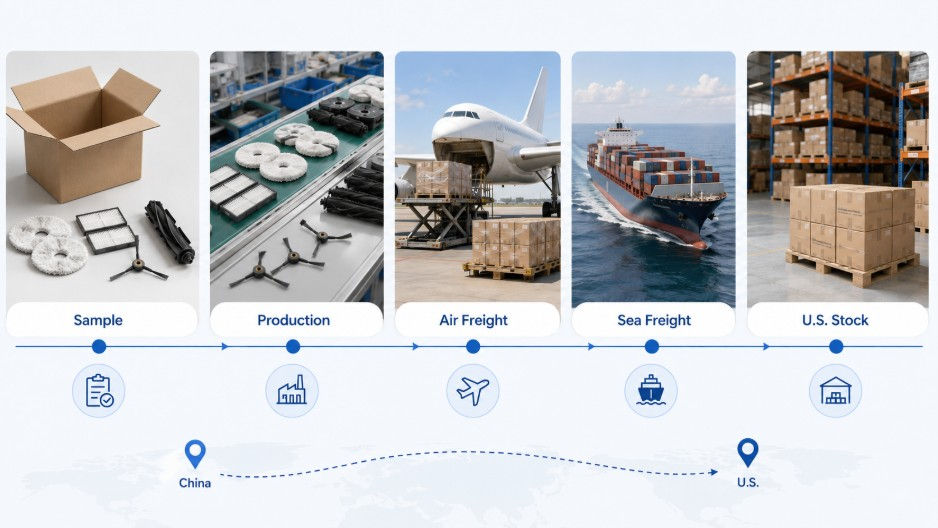
If sellers buy robot vacuum accessories from China, timing is just as important as product selection. Ocean freight from China to the U.S. often takes around 30–40 days under regular conditions, while air freight is usually much faster but more expensive. Freightos gives rough lead-time rules of about 3 days for air express, 8–10 days for air freight, and 30–40 days for ocean freight, depending on conditions.
That means sellers should not wait until Prime Day is over to start sourcing.
Time | Seller Action | Why |
4–6 weeks before Prime Day | Watch deal pages, early discounts, and best seller lists | Identify likely hot robot vacuum models |
3–4 weeks before Prime Day | Confirm samples, photos, and compatibility | Reduce wrong-fit returns |
During Prime Day | Track which robot vacuums receive strong discounts | Decide which parts to prioritize |
1–2 weeks after Prime Day | Place small mixed orders for urgent models | Catch early refill demand |
30–60 days after Prime Day | Push dust bags, filters, and mop pads | First replacement cycle may begin |
60–90 days after Prime Day | Promote complete kits and brush sets | Heavy users may start replacing brushes |
For urgent SKUs, air freight can be useful for small trial orders or fast replenishment. For stable models with larger demand, sea freight is more cost-effective, but sellers should plan earlier.
A balanced strategy is:
Use air freight for urgent refill kits and sample testing. Use sea freight for bulk replenishment once the model demand is confirmed.
How to Avoid Costly Compatibility Mistakes
Robot vacuum replacement parts often look similar, but small differences can cause returns. Before placing a bulk order, sellers should check:
Exact model number, not only the series name
U.S. version vs EU or China version
Dock type: dust bag or bagless base
Mop design: round mop pad, flat mop pad, or roller mop
Brush structure: rubber brush, bristle brush, or hybrid brush
Filter shape, frame size, and sealing design
Real product photos and sample testing before bulk orders
This is especially important for Amazon sellers because compatibility problems can quickly lead to negative reviews, higher return rates, and inventory waste.

A Practical Post-Prime Day Stocking Plan
For most sellers, the best plan is not to guess one “winning” product. Instead, build a small but flexible product mix.
A practical first batch may include:
Dust bag refill kits for self-emptying dock models
Mop pad and filter refill kits for mop-washing robots
Complete maintenance kits for high-visibility models
Pet hair maintenance kits for U.S. households
Small test orders for new or uncertain models
Sellers should also prepare product photos, compatibility charts, and clear listing text before the first demand wave starts. In many cases, a clear compatibility table can reduce customer confusion and lower return risk.
Final Thoughts
Prime Day creates more than short-term robot vacuum sales. It creates a later opportunity for aftermarket accessories. Sellers who plan early can be ready when buyers start searching for dust bags, filters, mop pads, side brushes, and main roller brushes.
For Amazon sellers sourcing from China, the winning strategy is simple: watch likely hot robot vacuum models, confirm compatibility early, test small mixed batches, and use the right shipping method based on urgency.
For buyers preparing robot vacuum replacement kits after Prime Day, techTongBo can support model-specific accessories, mixed kits, sample checking, and wholesale supply.
techTongBo (also named: Nanjing TongBo / NJTB) is a Chinese company specializing in the manufacture and sales of vacuum cleaner accessories. We offer replacement accessories for the global market that are compatible with mainstream vacuum cleaner brands and have stronger price advantages.


