

Robot Vacuum Mop Pad Manufacturer
According to current mainstream products on the market, robot vacuum mop pads are primarily divided into the following categories: single-piece vibrating mop pad (flat-plate type), dual spinning disc mop pads, roller mop pad, and crawler/track mop pad. These types are optimized for different cleaning needs. The materials are predominantly microfiber or chenille with excellent water absorption and wear resistance, and the manufacturing process mainly involves textile weaving combined with injection-molded fixing.
Based on official product specifications and real-world testing data, the differences are as follows:
Types of Robot Vacuum Mop Pads
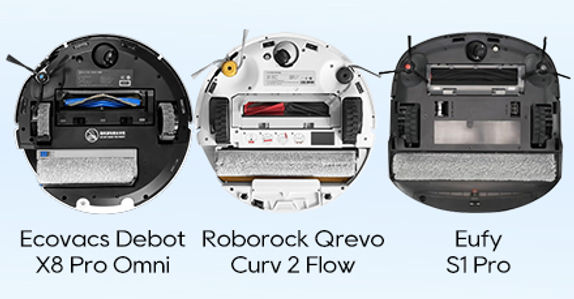
Single-piece Flat Vibrating Mop (flat-plate vibration / sonic mop)
Material: Microfiber + polyester blend, some models include silver-ion antibacterial coating, thickness 1.2–2 mm.
Manufacturing process: laser cutting → thermal pressing of Velcro or adhesive backing → edge stitching.
Design features: rectangular whole-piece mop pad fixed to the bottom of the water tank, relies on high-frequency vibration (300–4000 times/min) or left-right reciprocating wiping for stain removal; simplest structure.

Dual spinning disc mop pads (dual rotating mop)
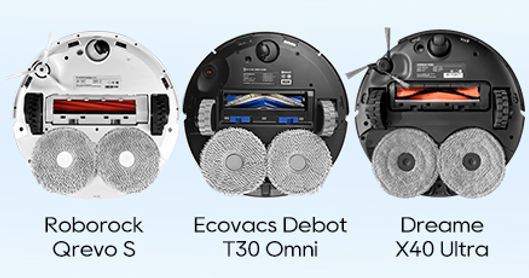
Material: round long-pile microfiber cloth (pile length 3–5 mm), rigid plastic base disc + Velcro, reinforced edge stitching to prevent fraying.
Manufacturing process: circular die cutting → multi-layer composite thermal pressing → edge stitching.
Design features: two discs rotate at 150–300 rpm with 8–15 N downward pressure, mimicking kneeling-and-scrubbing action; strongest stain removal performance.
Roller mop pad (peristaltic roller mop)
Material: chenille or high-density sponge + microfiber composite, water absorption up to 6–8 times its own weight.
Manufacturing process: fabric wrapped and bonded to plastic roller shaft → integrated injection molding, base station equipped with spray and scraper bars.
Design features: roller continuously rotates, spraying water while scraping and self-cleaning, keeping the mop pad in a constant semi-wet “fresh” state.
Crawler / track mop pad (wide crawler mop)

Material: 15–20 cm wide microfiber belt with inner TPU reinforcement layer to prevent stretching.
Manufacturing process: wide-width thermal compression forming → gear-engaged crawler structure → motor-driven rotation.
Design features: one wide crawler belt continuously flips, providing 6–8 fresh wiping surfaces in a single session; highest dirt-holding capacity.
techTongBo Factory is a professional manufacturer of sweeping robot accessories, including but not limited to mop cloths. In addition to various mopping pads for robot vacuums, our production scope also covers steam mop pads and regular manual mop cloths. Our mop cloth product line includes the following types:

6 Principles for Judging Mop Pad Quality
Drawing on over 10 years of professional mop cloth manufacturing experience, techTongBo shares the 6 hard-core principles for judging mop quality — every point is pure, practical insight:
-
Fiber Material Principle High-quality mop cloths must use ultra-fine microfiber (≤0.3 dtex). The finer the fiber, the stronger the capillary action for water absorption and stain adsorption, resulting in exponentially better cleaning performance. Coarse polyester fibers or non-woven fabrics can only “push” dirt around, never truly “capture” it.
-
Water Absorption & Release Balance Principle A good mop absorbs water quickly and holds a large volume, yet releases moisture evenly under pressure while carrying away dissolved dirt (thanks to capillary action + hydrophilic modification). Poor mops either repel water (hydrophobic) or hold it too tightly, leaving streaks and water marks.
-
Friction & Ground Contact Principle Thickness and elasticity determine contact pressure and surface coverage. Premium mops generate 300–500 g/cm² of uniform pressure when pressed by the robot, ensuring every fiber works against the floor. Thin, stiff mops only make contact at the edges — the center barely touches the ground.
-
Durability Principle Top-tier mops use thermal-bonded backing + high-strength overlock stitching to lock fibers in place permanently. Low-quality ones rely on glue; after a few hot washes or cycles, the adhesive degrades, causing immediate pilling, shedding, deformation, and hardening.
-
Antibacterial Principle Quality mops incorporate silver ions, quaternary ammonium compounds, or nano-zinc during fiber production or finishing, continuously inhibiting bacteria. Ordinary mops skip this step — within 24 hours in a damp environment, bacterial counts can exceed standards by 100×.
-
No-Streak Principle Superior mops receive dual hydrophilic + mild oleophobic surface treatment, allowing them to remove both water-based and oil-based stains while evaporating moisture rapidly. Inferior mops handle only one type of stain, leaving visible water marks or oily films.
6 Principles for Judging Mop Pad Quality
Custom Mop Pad Solutions for OEM/ODM Buyers

techTongBo offers full-chain customization capabilities — from raw material selection to finishing treatments. We can precisely match vibration frequency, downward pressure, and lift height for any robot model, and provide one-stop OEM/ODM services. Brands, private-label sellers, and cross-border merchants are all welcome to get in touch!